



Technology Platform Overview
This page outlines the core architecture, principles, and technologies that define how CreateMe is reinventing soft-goods manufacturing.
Powerful Systems. Strategic Design. Interdisciplinary Impact.
The Hardest Problem in Robotics
Soft-material assembly is one of the hardest problems in robotics. Fabrics stretch, drape, wrinkle, and shift unpredictably, making scripted automation brile and unreliable. Solving this challenge requires a blank-sheet, first-principles approach that rethinks how we design, sense, manipulate, and reason about soft materials.
A First-Principles Advantage
Most automation attempts in apparel start by imitating what a person does with a sewing machine. Sewing relies on needle penetration and tensioned feeding-actions that deform fabric and create an unstable control problem for robots. Bonding, by contrast, simplifies the task: single-sided access, static placement, and programmable join geometry that removes the mechanical constraints of stitching. By reframing garments as 2D and 3D forms to be shaped and bonded-not pierced and stitched-we created a solvable substrate for automation. Bonding also provides the correct foundation for Physical AI, creating predictable geometry and a controllable surface where learning-based systems can perceive, model, and act with far greater reliability.
A Market Defined by Scale and Variability
Apparel manufacturing is also defined by two opposing forces: extreme scale and extreme variability. The industry produces more than 100 billion units annually, yet those units span tens of billions of permutations across garment type, fabric, size, color, silhouette, and fit.
Reconciling Velocity and Variation
Any automation architecture must deliver high-speed throughput while accommodating this vast design space. CreateMe's insight was recognizing that these constraints don't need to be traded off-they can be harmonized. Our system design combines standardization in 2D fabric handling with modularity in 3D assembly, bringing order to complexity without sacrificing flexibility.
The Elegance of the MeRA Architecture
MeRATM reconciles velocity and variation through this unified approach, enabling a platform that scales while adapting to the diversity of modern apparel.
A Unified Technology Stack
Delivering this architecture requires a unified technology stack. The mechanics of 2D handling, the geometry control of 3D forms, the precision of digital bonding, and the adaptability of Physical Al must operate as one integrated system. Unifying robotics, bonding, and intelligence enables single-sided access, stable material control, and software-driven assembly-setting the foundation for the three pillars that follow.
Explore the three pillars of our technology
Robotics
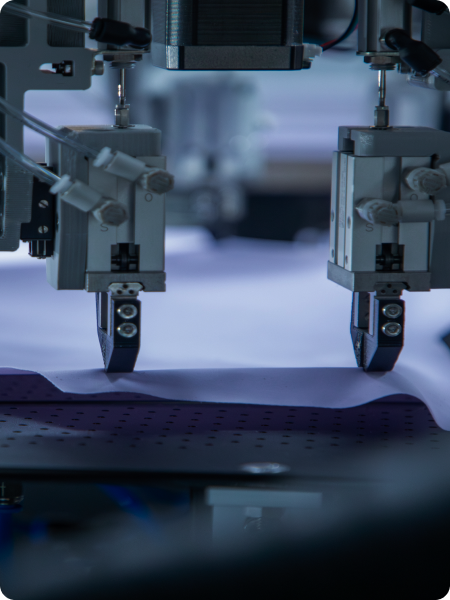
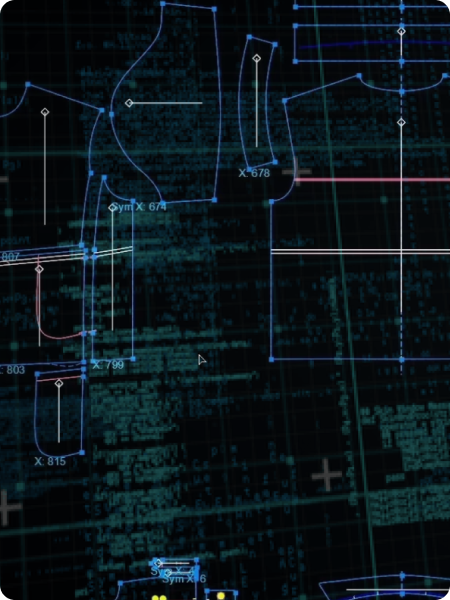
The world’s first autonomous tailoring platform; a robotic system built with proprietary mechanical tooling and adaptive 2D and 3D forms that control, shape, and position fabrics for precise soft-goods assembly.
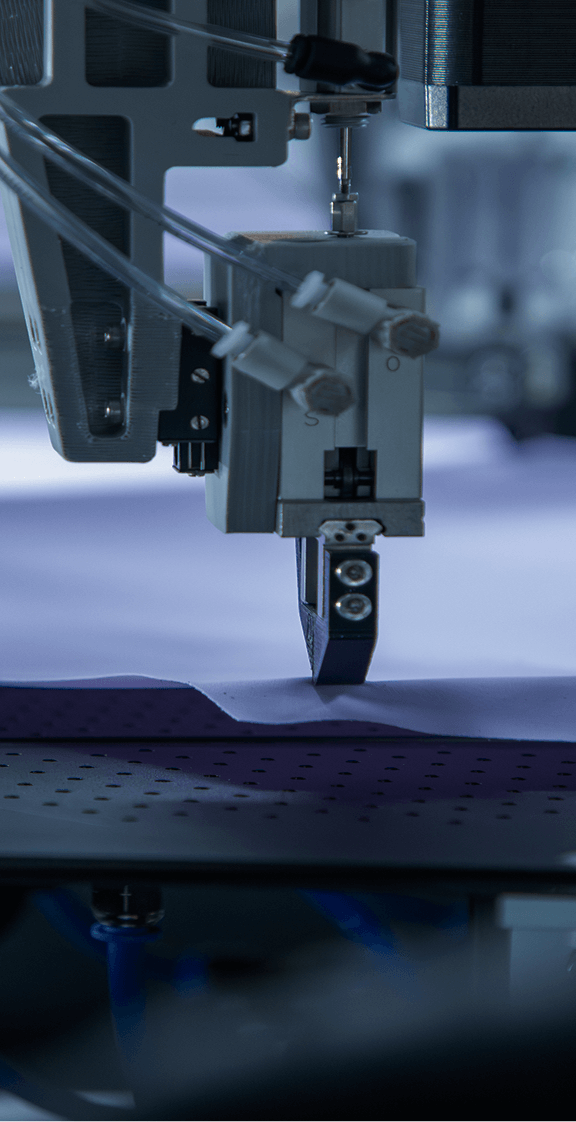
The MeRA™ platform is the first fully autonomous tailoring system—an end-to-end robotic line engineered for the challenges of deformable materials. MeRA combines industrial-grade robotics with a suite of proprietary mechanical innovations: adaptive 2D forms that stabilize and tension flat fabric panels, adaptive 3D forms that shape and support garment geometries, precision fixturing that manages stretch and drape, and custom tooling that folds, aligns, and positions materials so they can be bonded with micrometer-level accuracy.
Each module uses dynamic 2D and 3D forms, supported by material-aware fixturing, to control fabric geometry across every step—guiding panels, holding contours, managing tension, and ensuring consistent alignment. This enables robots to perform sewing-equivalent motions—placing, folding, tracing seams, pressing, and bonding—at speeds up to 20× faster and with 2× the precision of manual methods, producing ~250 garments per hour in a compact footprint.
By turning garment construction into a sequence of robotic manipulation tasks supported by engineered 2D and 3D forms and tooling, MeRA delivers high repeatability, fast changeovers, and reliable SKU variability without hard tooling, bringing robotics to soft-goods manufacturing at commercial scale for the first time.
Adhesives
A digital bonding process that replaces stitching in everyday apparel, delivering stronger, cleaner, and fully automatable joins across apparel and other soft goods.
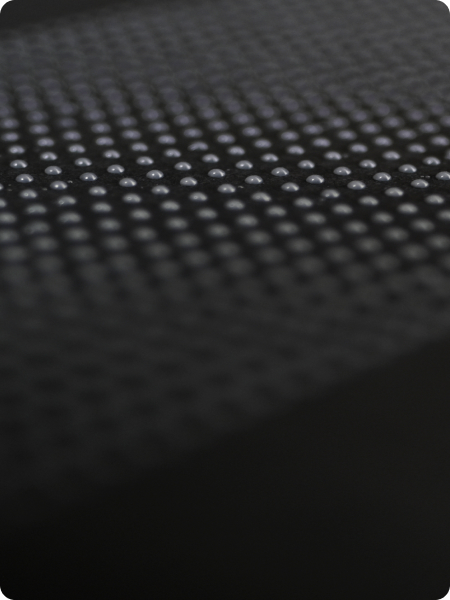
Automating soft-material assembly required rethinking the joining process itself. Pixel™ is a digital micro-adhesive joining process—purpose-built for apparel—that replaces the mechanical limitations of stitching with a faster, cleaner, and more consistent method of forming seams.
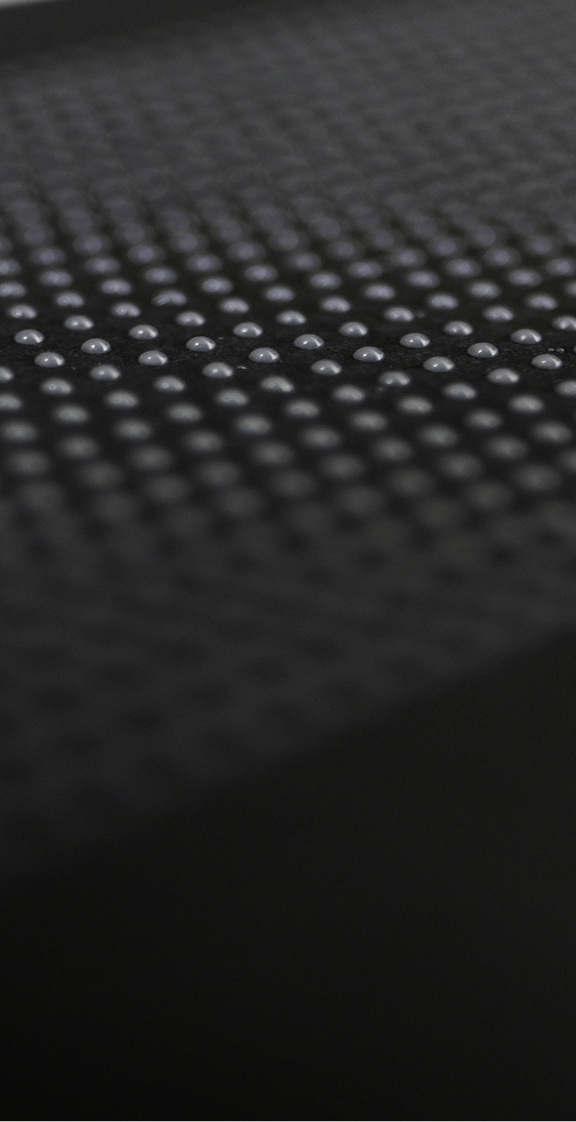
Pixel applies adhesive in high-resolution micro-patterns that control strength, stretch, flexibility, and drape for each join. The process deposits, activates, and cures these patterns with precision, creating stitch-equivalent or superior bonds without thread tension, needle perforation, or operator variability. The result is a seam that is lighter, stronger, and more uniform than conventional stitches or bonded tape.
Because Pixel is a programmable process, it scales seamlessly into automation. Its deposition geometry, thermal profile, and cure behavior are engineered to work in robotic workflows, enabling consistent seam formation across diverse fabrics, hybrid materials, and complex garment geometries. Thermo(re)set™ extends this capability with reversible bonds for repair, rework, and material recovery, supporting circularity in casual apparel at scale.
By pioneering a digital bonding process for everyday garments, Pixel transforms how soft goods are constructed. It moves joining from a mechanical craft to a precise, software-guided operation, unlocking speed, quality, and design freedom while forming the foundation for truly on-demand, automated apparel production.
Physical AI
Physical AI is the software and data layer that enables CreateMe to scale automation across garment types, fabric types, and future soft-material uses; it adapts to material variability in real time and drives greater speed, flexibility, and scalability.
Physical AI is the foundation of CreateMe’s software and data strategy for soft-material automation. It extends our early CV/ML perception work—where algorithms identify fabrics and track geometry—into a broader, forward-looking system aimed at understanding, predicting, and responding to real-world material behavior.
This emerging stack brings together perception, prediction, control, and simulation. It is being trained on a proprietary data pipeline built from thousands of production scenarios across garment and material types. These datasets support our growing suite of vision models, state estimators, and motion-control policies, forming the basis for more adaptive decision-making over time.
As Physical AI matures, it will enable automation to behave less like scripted motion and more like adaptive response. The system is being developed to determine how to tension panels, anticipate seam paths as materials shift and correct for geometry changes—all capabilities that unlock broader fabric and garment variability without requiring hardware redesigns.
By shifting more complexity into software, Physical AI is designed to reduce reliance on highly specialized robotics and mechanical tooling, lower overall capex requirements, and enable simpler, more extensible systems. This approach positions CreateMe to scale more efficiently and extend into additional soft-material manufacturing domains as the technology advances.
Physical AI is the roadmap enabler that will allow our platform to expand across garment and fabric types and support the next generation of adaptable, autonomous soft-goods manufacturing.
CreateMe is building viable on-shore apparel manufacturing using
Physical AI, robotics, and adhesives.
Explore our Products:
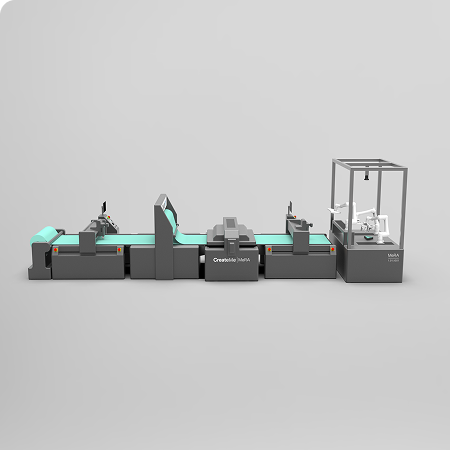
MeRATM
The world's first autonomous tailoring platform. Five steps to dynamic variability and flawless precision.
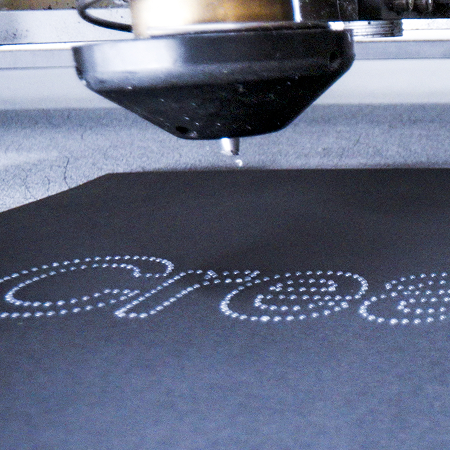
PixelTM
A game-changing digital microadhesive that demonstrably outperforms thread and bonded tape.
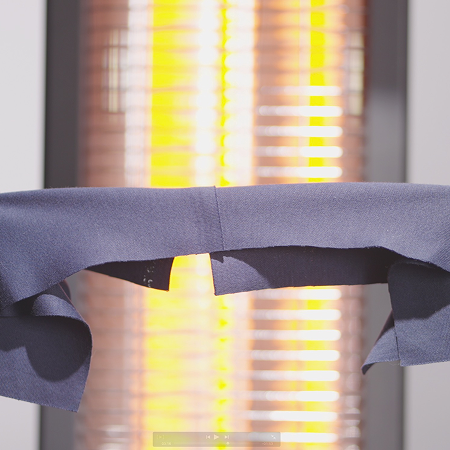
Thermo(re)setTM
The world's first reversible adhesive for circular fashion that enables end-of-life disassembly for meaningful recycling.
Learn More
Got questions? We’ve got robots (and humans) ready to help.